
Troubleshooting
Why is my water pressure low?
Updated · Editorial team; not yet technically reviewed
Short answer
If only one faucet is weak, the cause is usually at that fixture: a clogged aerator or cartridge. If the whole house is low, check that the main shutoff and meter valve are fully open, then look at the pressure reducing valve, old galvanized pipes narrowed by scale, a hidden leak, or a supply problem from the utility.
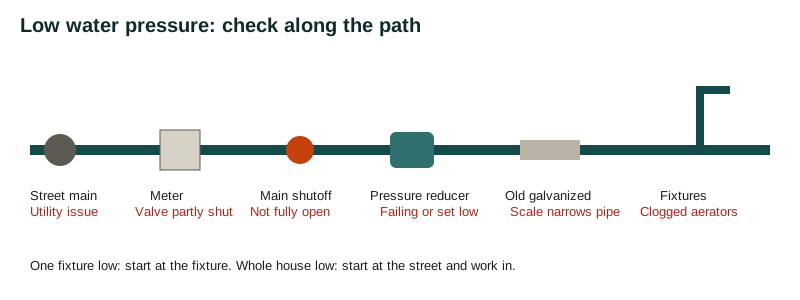
Trace it along the path
| Pattern | Likely cause | Check or fix |
|---|---|---|
| One faucet or shower | Clogged aerator, showerhead or cartridge | Clean or replace the aerator or cartridge |
| Hot water only | Water heater valve, sediment, or heater supply line | See water heater repair |
| Whole house, suddenly | Utility work, main break, or a valve bumped shut | Ask neighbors; check the main valve |
| Whole house, gradually | Failing pressure reducing valve or scaled galvanized pipe | Test pressure; consider repiping |
| Pressure drops and the meter spins with taps off | Leak | See leak detection |
Test it yourself
Get a gauge
A hose-thread pressure gauge from a hardware store.
Measure
Attach it to an outdoor faucet near the meter with everything else off.
Read it
Many homes run around 40 to 60 psi; well below that points upstream, and above about 80 psi strains fixtures.
Who to call for low pressure
If the whole neighborhood has low pressure, it's the utility's problem: a main break, firefighting nearby, or peak demand. Check with neighbors or the utility's outage page before calling a plumber. If only your house is affected, the cause is usually on your side: a partly closed main valve after recent work, a failing pressure reducing valve, a clogged whole-house filter, or a leak in the service line.
If only one fixture is weak, clean its aerator or showerhead first; mineral scale often clears with an overnight soak in vinegar. If only hot water is weak, look at the water heater's shutoff valve and sediment in the tank. Pressure that is fine in the morning and drops during the day, or that slowly declines over years, points to galvanized pipe narrowing from the inside, which only replacement fixes.
Common questions
Does water pressure change during the day?
It can dip at peak morning and evening demand, especially on the edges of a utility's system.
Can a pressure reducing valve cause low pressure?
Yes. A failing or misadjusted valve can drop pressure for the whole house.
Do old galvanized pipes lower water pressure?
Yes. Rust and scale build up inside and narrow the pipe over decades.
Where do I attach a gauge to test water pressure?
On an outdoor hose faucet near the meter, with all other water turned off.
Can a leak cause low water pressure?
A large leak can; if the meter moves with every tap off, look for one.
Can a partly closed main shutoff lower pressure?
Yes. After other work, the main or meter valve is sometimes left partly closed; open it fully.
Does low pressure affect water heaters?
It can reduce hot water flow; sediment in the heater also restricts hot-side pressure.
General information; codes vary by location. See our editorial standards.