
Sewer problems
Trenchless sewer repair explained
Updated · Editorial team; not yet technically reviewed
Short answer
Trenchless repair fixes a sewer line through small access pits instead of a full trench. Lining slides a resin-soaked tube into the old pipe and cures it into a new pipe inside; pipe bursting pulls a head through the old pipe that splits it while dragging new pipe in behind. Lining suits cracked pipe that's still in line; bursting suits collapsed or undersized pipe. Sags and severe offsets usually still need excavation.
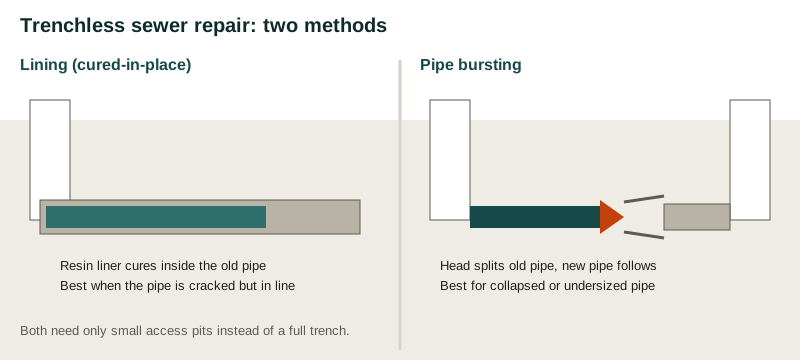
The two main methods
| Lining (CIPP) | Pipe bursting | |
|---|---|---|
| How | Resin liner cured inside old pipe | Head splits old pipe; new pipe pulled in |
| Best for | Cracks, root entry, minor offsets | Collapsed, crushed or undersized pipe |
| Pipe diameter | Slightly smaller | Same or larger |
| Access | One or two openings | Launch and receiving pits |
When trenchless won't work
- A belly (sag) that holds water: lining follows the sag, so it stays.
- Severe offsets or a fully collapsed section the liner can't pass.
- Some materials and soil conditions limit bursting near other utilities.
Questions to ask before you sign
Show me the video
A camera inspection should show why trenchless fits.
What about the connections?
Ask how side connections and the tie-in to the main are handled.
Permits and warranty
Ask who pulls permits and what the liner or pipe warranty covers.
After the work: warranties and follow-up
Ask for the post-repair camera video, and keep it alongside the pre-repair footage. It shows the liner or new pipe is smooth, the joints are sealed, and branch connections were reopened; a reputable contractor provides it without being asked. Note the liner or pipe material, its rated life, the length installed and the access points used, since the next plumber will need that information.
Warranties vary widely, from a few years to decades, and often cover only the lined or replaced section, not the city connection or the pipe beyond it. Read whether the warranty transfers to a buyer, and whether it requires periodic cleaning or inspections. Grease, wipes and roots can still collect at transitions, so routine care still matters. If backups return, a camera inspection quickly shows whether the problem is in the new section or somewhere the repair didn't reach.
Finally, confirm the permit was closed with a final inspection where your city requires one; an open permit can surface during a sale and delay closing.
Common questions
How long does a sewer pipe liner last?
Manufacturers commonly rate cured-in-place liners for decades; ask for the specific product warranty.
Does lining make the sewer pipe smaller?
Slightly, by the liner's thickness, but the smooth interior often flows as well or better.
How are side connections handled after lining?
They're reopened from inside with a robotic cutter, or reconnected at an access point.
Is pipe bursting safe near other utilities?
It needs care near gas, water and electric lines; locating utilities first is standard.
Do trenchless repairs need a permit?
Generally yes, like other sewer repairs.
How much yard is disturbed by trenchless repair?
Usually one or two small pits instead of a trench along the whole line.
General information; codes vary by location. See our editorial standards.