
Plumbing service
Sewer line repair
Short answer
Sewer line repair fixes the pipe that carries wastewater from your house to the public sewer (or septic tank). The problem is found with a camera inspection, and the fix ranges from a single excavated spot repair to trenchless relining or full replacement, depending on how much of the pipe is damaged and what it's made of.
Updated · Editorial team; not yet technically reviewed
Sewer Line Repair at a glance
- Diagnosis
- Camera inspection through a cleanout, with a locator to mark depth and position.
- Repair options
- Spot repair, trenchless relining (CIPP), pipe bursting, or open-trench replacement.
- Who owns it
- Usually the owner, from the house to the property line or the main; rules vary by city.
- Permits
- Excavation and sewer connection work generally needs a permit and inspection.
Signs your sewer line needs attention
- Several drains slow or back up at the same time, especially the lowest fixtures
- Gurgling from a toilet or tub when another fixture drains
- Sewage odor outside near the line, or indoors without a clear cause
- A wet, sunken or unusually green strip of lawn along the sewer path
- Main line clogs that return within weeks of being cleared
How a sewer camera inspection works
Access
A waterproof camera on a push cable goes in through a cleanout, or through a toilet opening if there's no cleanout.
Recording
The plumber pushes the camera to the main or the tank, recording video and noting the distance at each defect.
Locating
A transmitter in the camera head lets them mark the defect's position and depth on the ground above.
Review
You should be able to see the footage and have each defect pointed out: roots, cracks, offset joints, sags ("bellies") or collapse.
Pipe material matters
| Material | Found in | Typical problems |
|---|---|---|
| Vitrified clay | Many older homes | Root intrusion at joints, cracking, offset joints |
| Cast iron | Older homes, under slabs | Interior corrosion and scale, cracking, channeling along the bottom |
| Orangeburg (bituminous fiber) | Some homes built roughly 1940s–1970s | Deforms and collapses with age |
| PVC / ABS plastic | Newer homes and past repairs | Generally durable; failures usually from settling or poor installation |
Repair options compared
| Method | How it works | Fits when | Trade-offs |
|---|---|---|---|
| Spot repair | Dig at one defect and replace that section | Damage is in one place | Excavation, but limited to one spot |
| Relining (CIPP) | A resin-soaked liner is cured inside the old pipe | Pipe is cracked or leaking but still holds its shape | Minimal digging; slightly smaller diameter; needs a cleaned pipe |
| Pipe bursting | A new pipe is pulled through, breaking the old one outward | Pipe is badly damaged along its length | Small access pits; not suited to every soil or nearby utility |
| Open-trench replacement | Dig along the line and lay new pipe | Collapse, severe sags, or when trenchless won't work | Most disruption to yards, driveways or landscaping |
Trenchless methods can't fix a sag, because the liner follows the existing pipe. A belly usually needs excavation.
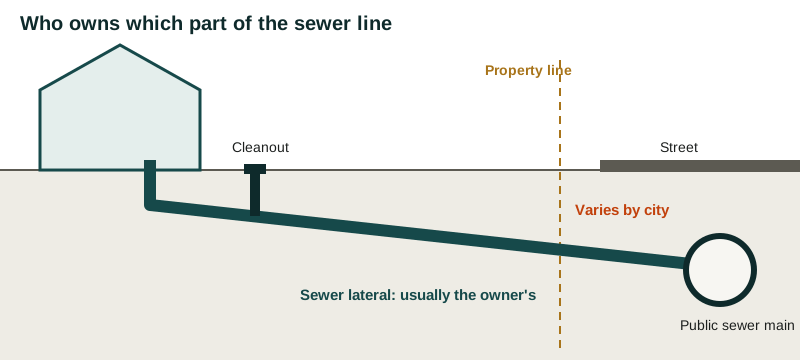
Who pays for which part
The pipe from your house to the public main is called the lateral. In most US cities the homeowner owns at least the part on private property, and many cities make the owner responsible all the way to the main, including under the street. Some utilities share or take over responsibility past the cleanout or property line.
Before approving work near the street, call your sewer utility and ask where the owner's responsibility ends. Some utilities and insurers offer service-line coverage, and it's worth checking your policy.
Problems that lead to sewer line repair
Common questions
How do I know if my sewer line needs to be replaced?
A camera inspection tells you. Replacement is usually recommended when the pipe has collapsed, is broken in several places, has a significant sag, or is Orangeburg pipe that's deforming. Isolated defects can often be spot-repaired or relined.
Does homeowners insurance cover sewer line repair?
Standard policies often exclude wear, tree roots and deterioration of the sewer line. Some insurers sell a separate service-line endorsement. Read your policy or ask your agent.
Is trenchless sewer repair always better?
No. It's less disruptive when it fits, but it can't correct a sag and needs a pipe that still holds its shape (for relining) or suitable soil conditions (for bursting).