
Plumbing service
Water heater repair
Short answer
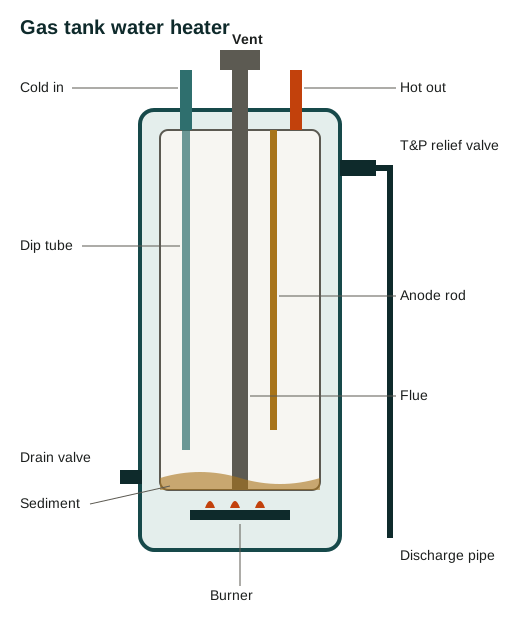
Most water heater problems come from a handful of parts: the pilot, thermocouple or igniter on gas models, the heating elements or thermostats on electric models, the temperature and pressure relief valve, and sediment in the tank. These are repairable. A leak from the tank body itself is not, and means replacement.
Updated · Editorial team; not yet technically reviewed
Water Heater Repair at a glance
- Gas: no hot water
- Pilot out, faulty thermocouple or flame sensor, igniter, or gas valve.
- Electric: no hot water
- Tripped breaker or high-limit reset, failed element or thermostat.
- Not enough hot water
- A failed lower element, broken dip tube, sediment, or an undersized heater.
- Repair vs. replace
- Tank leaks and old units needing major parts usually mean replacement.
Troubleshooting by symptom
| Symptom | Likely causes | Safe homeowner check |
|---|---|---|
| No hot water (gas) | Pilot out, thermocouple, igniter, gas valve | Follow the relighting instructions on the label; if it won't stay lit, call |
| No hot water (electric) | Breaker, high-limit cutoff, element, thermostat | Check the breaker; don't open the element panels with power on |
| Runs out fast | Lower element failed, dip tube broken, sediment, undersized | Note how long hot water lasts; have the plumber test elements |
| Rumbling or popping | Sediment on the tank bottom | Flushing may help; see maintenance |
| Rotten-egg smell in hot water | Bacteria reacting with the anode rod | A plumber can disinfect the tank and change the anode type |
| Water at the T&P discharge pipe | Excess pressure or temperature, or a worn valve | Call; don't cap or plug the pipe |
| Water pooling under the tank | Fitting, valve, or tank leak | Find the source; a tank leak means replacement |
The temperature and pressure relief valve
The T&P valve is the water heater's main safety device. It opens if tank temperature or pressure gets too high, discharging water through a pipe that should end near the floor or at an approved drain. A valve that drips repeatedly may be worn, or it may be responding to high pressure from thermal expansion in a closed system. The fix may be a new valve, an expansion tank, or a pressure-reducing valve. Never plug or cap the discharge pipe.
What to leave to a plumber
- Anything involving the gas valve, gas connector or burner assembly.
- Electrical work inside the element compartments.
- Venting problems, soot, or scorching around the burner opening. These can indicate combustion problems; if you suspect carbon monoxide, get everyone outside and call 911.
- Replacing the T&P valve or anode rod on a heater that's been neglected, since fittings can be seized.
Is the repair worth it?
Compare the repair cost with the heater's age. A thermocouple or element on a five-year-old heater is an easy call. A gas valve on a heater near or past ten years old often isn't worth it, because the tank itself is nearing the end of its life. See water heater replacement for choosing a new unit.
Methods and specific problems
Problems that lead to water heater repair
- Water heater leakingWhere a water heater leak is coming from tells you whether it's a cheap fix or a new tank. How to find it safely, and what to shut off first.
- No hot waterWhy a house suddenly has no hot water, or runs out fast, with separate checks for gas, electric and tankless heaters and when to call.
- Water heater making noiseWhat popping, rumbling, hissing, ticking and screeching from a water heater mean, which are harmless, and which need a plumber.
- Hot water smells like rotten eggsWhy only the hot water smells of sulfur, how the water heater's anode rod is involved, and the fixes that work, plus when the smell could be gas.
- Brown or rusty waterWhy tap water turns brown or rusty, how to tell a city main issue from corroding galvanized pipe or a water heater, and when to stop drinking it.
Common questions
Why does my gas water heater pilot keep going out?
Common causes are a failing thermocouple or flame sensor, a dirty pilot tube, drafts, or a venting problem. If it won't stay lit after relighting per the label, call a plumber.
Why do I have hot water but not enough of it?
On electric heaters, a failed lower element is common. Other causes are a broken dip tube mixing cold into the hot, heavy sediment, or a heater too small for the household.
Is it safe to use a water heater that's leaking?
Shut off the cold supply and the fuel or power if the tank is leaking. A dripping fitting may be fixable, but a tank leak can suddenly get worse.